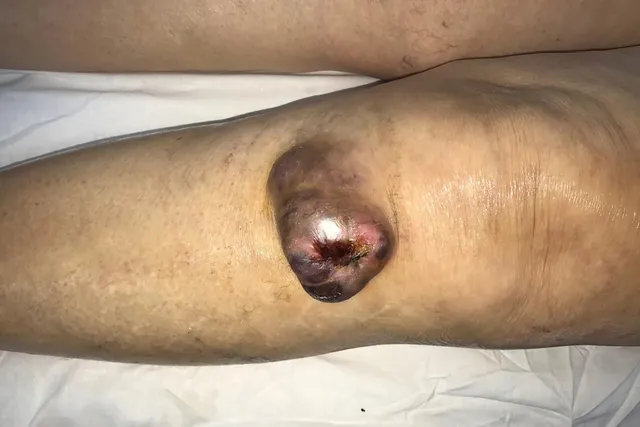
Tenosynovial giant cell tumors (TGCTs) are rare tumors that affect your joints, most commonly your knees, fingers, wrists, and elbows. The growths are noncancerous (benign) tumors. Because TGCTs grow in your joints, they can cause complications, some of them serious.
Sometimes the problems can come from the treatments, like surgery. Learning about TGCT, the treatments, and side effects can help you get the best care.
How Do TGCTs Change Your Joint?
When a TGCT begins to grow in your joint, the tumor can affect three parts:
- Synovium, the thin lining on the inner surface of the joint
- Bursae, the small, fluid-filled sacs that provide a cushion between the joints and tendons
- Tendon sheath, the thin lining surrounding the tendons
As the tumor grows, it can cause the tissue in your joint to thicken, swell, or make extra fluid. This puts pressure on the cartilage (tissue that acts as a shock absorber in your joints and protects the bones from rubbing together) and the bone surrounding the joint.
If the tumor continues to grow, the cartilage starts to wear away. Eventually, the bones start to rub together, causing arthritis.
What Are Symptoms of TGCT?
You may not have symptoms, but if you do, they may start with swelling and joint stiffness. The swelling, pressure, and friction in your joint can also cause:
- A lump or bump in the joint
- Pain, especially when moving the joint
- Skin that feels warm or tender over the joint
- A sensation that your joint is locking or catching
- Breaks (called fractures) in the bones around the joint
Another problem related to TGCTs is that these tumors can grow back after surgery. They can be recurrent, which means you might need more surgeries over time.
Do I Need TGCT Treatment Right Now?
Not all TGCTs must be treated at first. In some cases, doctors choose to use active surveillance or "watchful waiting" to see if the tumor will grow, cause symptoms, or cause damage.
If you choose active surveillance, your doctor will watch you closely. You'll go in for regular tests to see what the tumor is doing. If the tumor starts to progress or cause damage, you and your doctor will talk about treatment options.
Talking to an orthopedic specialist, a doctor who treats bones and muscles, can help. If you don't have symptoms, waiting may be an option. This is especially true for diffuse TGCT, which can return after surgery.
What Happens if I Have TGCT Symptoms and Don't Get Treatment?
If you have TGCT symptoms but ignore them and don't get treatment, the tumor can continue to grow. The growth can fill the joint and enter nearby tissues. Over time, the TGCT can grow bigger and put pressure on your joint, tendons, and tissues.
What Are Surgery Side Effects?
All medical treatments have some possible side effects, complications, or long-term effects. Some are more serious than others. Here are some of the more common ones related to TGCT treatments.
Arthroscopic surgery recovery
Arthroscopic surgery (also called arthroscopy) uses a camera and special tools. So the cuts (incisions) are smaller, and you'll usually have a shorter recovery and rehabilitation time than you would if you had an open surgery.
Open surgery recovery
Open surgeries use a larger incision so the surgeon can see inside the joint. Rehabilitation should start within one to two days if there are no complications or issues that prevent you from starting. At the very least, you will likely have to do some range-of-motion exercises so you can use your joint again.
Possible complications after having any surgery include:
- Nausea and vomiting
- Pain where you had the surgery
- Sore throat from the intubation (the tube placed in your throat)
- Infections
- Blood loss
Complications that could happen after surgery specifically for TGCTs include:
- Cartilage damage
- Scarring
- Joint stiffness
- Bleeding in the joint (hemarthrosis), which may need draining
- Less joint movement
Long-term effects could include:
- Osteoarthritis
- Less joint movement
- Tumors coming back again (recurring), requiring another surgery
What Are TGCT Treatment Side Effects?
If your doctor chooses to treat the TGCT with medications, potential side effects depend on your choice, such as pexidartinib (Turalio) or vimseltinib (Romvimza). Your doctor and pharmacist can help answer questions about any concerns you may have about the medicine.
Some of the most common side effects of targeted treatments include:
- Fatigue
- Swelling
- Rash
- Itching
- Pain, tingling, or burning in your hands, feet, arms, and legs (peripheral neuropathy)
Your doctor may also test you often to check your liver health. They'll let you know if they need to change your medicine to keep you liver healthy.
Other medications
Sometimes, doctors use medicines that are approved for other medical conditions, also called off-label use. Your doctor may suggest a medicine such as imatinib (Gleevec) or nilotinib (Tasigna).
Some of the most common side effects of imatinib, which is used off-label, include:
- A feeling of acid or "sourness" in your stomach
- Burping, passing gas
- A hard time having a bowel movement or having frequent or loose stools
- Feeling unusually cold
- Feeling sad, losing interest or pleasure in life
- Muscle stiffness
- Night sweats
Some of the most common side effects of nilotinib, which is used off-label include:
- Back pain
- Burning, itching, and pain in areas of your body that have a lot of hair
- Diarrhea
- Joint pain or swelling
- Pain in your arms or legs
- Pus at the root of your hair
Radiation therapy
Radiation therapy isn't often used for TGCT anymore because it can come with serious side effects and studies have not shown benefit. Here are some common problems that radiation can cause:
- Joint stiffness
- Joint damage
- Tissue thickening or scarring (fibrosis)
- Another type of cancer
Can Rehab Help?
If you have surgery to remove a TGCT, rehabilitation (rehab) can help heal your joint and make sure you get the best range of motion and use as possible. How much physical therapy and rehabilitation you will need depends on:
- How severe the tumor was
- Where the growth was
- How extensive the surgery was
Exercises for recovery and rehab
Range-of-motion exercises help your joint:
- Get stronger
- Increase or improve endurance
- Maintain and increase its current range of motion
These exercises can also promote circulation and blood flow to the area.
Ask your care team about a continuous passive motion (CPM) machine. It's a device that can help your leg move without putting extra pressure on the joint. This can help lower joint stiffness and prevent scars from developing in your joint, also called joint adhesions.
You and your doctor can talk about your TGCT rehab plan to lower your chance of complications. Knowing your risks and getting your medical team involved is a great start. That way, you can make the best informed decision.
Show Sources
Photo Credit: iStock/Getty Images
SOURCES:
Aurora BayCare Medical Center: "Upper Extremity Active Range of Motion – Sitting."
Cleveland Clinic: "Cartilage," "Giant Cell Tumors."
European Journal of Surgical Oncology: "Active surveillance of diffuse-type tenosynovial giant cell tumors: A retrospective, multicenter cohort study."
Hematology/Oncology and Stem Cell Therapy: "Updates on the Treatment of Tenosynovial Giant Cell Tumor (TGCT)."
Johns Hopkins Medicine: "After Surgery: Discomforts and Complications."
Mayo Clinic: "Pexidartinib (Oral Route)," "Imatinib (Oral Route)," "Nilotinib."
Merck Manual: "Joint Tumors."
Nationwide Children's: "What Are Tenosynovial Giant Cell Tumors?"
National Organization for Rare Disorders: "Tenosynovial Giant Cell Tumor."
PLOS One: "Treatment, recurrence rates and follow-up of Tenosynovial Giant Cell Tumor (TGCT) of the foot and ankle – A systematic review and meta-analysis."
TGCT Support: "Treatment," "Radiation," "Physical Therapy."
UpToDate: "Treatment for tenosynovial giant cell tumor and other benign neoplasms affecting soft tissue and bone."