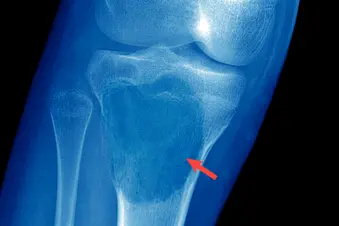
What Is a Tenosynovial Giant Cell Tumor?
Tenosynovial giant cell tumors (TGCTs) grow from the soft tissue in and around your joints. These tumors are called benign because the growths rarely spread to other parts of your body and aren't life-threatening.
If you zoom in and look at these tumor cells under a microscope, you'll see clusters of unusually giant cells. The word "tenosynovial" describes the tissues around your tendons, joints, and bursae that make fluid to cushion your joints.
TGCTs can grow from:
- Tendon sheaths or layer of membrane covering your tendons – the fibrous tissue connecting your muscles and bones
- Synovium, the thin layer of tissue covering the surfaces of your joint spaces
- Bursae, the protective fluid-filled sacs where your muscles, tendons, and bones meet
Location matters; TGCTs can overgrow in a joint or body part, making it harder to move. The tumor can also damage your joint and nearby tissues. Without treatment, the overgrowth can:
- Cause pain
- Grow fast
- Lower quality of life
If you have surgery to remove one, the TGCT can still come back, or recur.
Localized vs. diffuse TGCT
If your TGCT is localized, then it's limited to a particular place. But diffuse TGCTs spread out inside your joint.
Localized TGCTs can grow anywhere in your body where you have joints. They usually start as a small growth or nodule that's connected to the affected part of your joint with a stalk. They also will look well-defined or encapsulated.
Most localized TGCTs will be in or around the joints of your fingers, hands, and wrists. It's less common to get them in joints of your foot, ankle, knee, hip, or other joints. Doctors used to call a localized TGCT a giant cell tumor of the tendon sheath (GCTTS) or nodular synovitis.
Diffuse TGCTs tend to grow faster and cause more problems. They're called diffuse because they spread out over a bigger area of your joint instead of being in a smaller, well-defined spot.
Diffuse forms happen mostly in your larger joints, including your:
- Knee
- Hip
- Ankle
- Elbow
- Shoulder
More rarely, diffuse TGCTs can affect the joints connecting your jawbones to your skull or the joints between the bones in your spine (vertebrae). Doctors used to call TGCTs pigmented villonodular synovitis (PVNS).
TGCT vs. ganglion cysts
Another type of growth or lump you can get around your joints is called a ganglion cyst. Ganglion cysts are filled with fluid and just under your skin. But TGCTs grow from the tissues in and around your joints. If you have any type of lump or growth and you don't know what it is, it's a good idea to see your doctor.
Who Gets Tenosynovial Giant Cell Tumors?
TGCTs aren't common, but anyone can get them. They happen more often in women and adults between ages 30 and 50.
TGCTs don't have any known risk factors that make them more likely or help to explain why some people get them and others don't. In fact, less than 50 in every 1 million people around the world will get a TGCT each year. This makes them very rare. But if you've had one TGCT, you are likely to have it come back.
What Causes Tenosynovial Giant Cell Tumors?
It's not clear what causes TGCTs. Under a quarter of TGCT cells have DNA changes (abnormalities) called chromosomal translocations. Your cells normally have 46 chromosomes, which contain your DNA.
But when a piece of one chromosome breaks off and attaches to another one, tumors can grow. The specific translocation often found in TGCT involves parts of chromosomes 1 and 2. The swapping parts of chromosomes 1 and 2 can cause higher levels of colony stimulating factor-1 (CSF-1).
More CSF-1 protein can attract other cells, including white blood cells called macrophages. And higher levels of CSF-1 can bring more macrophages and other inflammatory cells. Your TGCT likely causes the inflammation and other symptoms of TGCT.
While doctors now know the causes of TGCTs, it isn't clear why this happens. The chromosomal abnormality that leads to increases in CSF-1 might just happen randomly and for no reason.
Symptoms of Tenosynovial Giant Cell Tumors
Swelling is often one of the first things you'll notice if you have a TGCT. You're more likely to have pain earlier on if your TGCT is diffuse and more widespread. But either type can cause pain. You may also notice stiffness or trouble moving your joint that gradually gets worse.
Because TGCT is rare and early symptoms aren't clear, it's likely you won't recognize it at first. Your symptoms can depend on:
- Where your TGCT is
- Which type of joint tissue your TGCT is in
- How big it is
- How fast it grows
Tenosynovial Giant Cell Tumor Diagnosis
TGCTs often get diagnosed years after symptoms develop. On average, TGCTs are diagnosed three to four years after symptoms start.
Your doctor will diagnose TGCTs based on your symptoms. They will ask you lots of questions about your medical history and give you a physical exam. They will likely order imaging tests, including:
- X-rays to rule out other conditions and look at any damage in your affected joint
- Magnetic resonance imaging (MRI) to see smaller changes in your joint and growth, including blood vessels and certain changes specific to TGCTs
It's important to know if your TGCT is localized or diffuse. Your doctor can tell from MRI images showing changes in the way your cells are acting.
Other tests
Your doctor might take a sample of your joint fluid. When you have a TGCT, your joint fluid may have blood in it.
They may also want to take a biopsy to help confirm that you have a TGCT. Your doctor can look at your joint tissue under a microscope to see what type of cells are in it. Many times, they can diagnose your TGCT with the MRI image alone.
Tenosynovial Giant Cell Tumor Surgery
The best treatment for your TGCT depends on the type of TGCT you have and other things, like your health, medical conditions, and where the tumor is growing.
If you have localized TGCT, your doctor may suggest surgery. If you have symptoms, surgery is commonly suggested as a first option and potential cure. But TGCTs can sometimes come back again, about 10% to 15% of the time.
Diffuse TGCTs are harder to remove with surgery. At least half the time, diffuse TGCTs removed with surgery come back again. If your doctor takes out your TGCT, and it comes back, you're even more likely to have other recurrences.
Type of surgery
There's no standard way to remove TGCTs. You may have a synovectomy. It's a surgery that removes the lining of your joint. You could have this done in an open surgery or using a small cut (minimally invasive). If your surgeon uses a small cut, they use a small instrument with a tiny camera to do your surgery.
In the past, radiation was suggested for severe TGCT when surgery wasn't an option, but not anymore. If surgery doesn't work, your doctor may talk to you about a joint replacement or medicine.
Medicines to treat TGCT
Medicines can block the protein that causes the growths to form, called colony stimulating factor-1 (CSF-1). You may treat your TGCT with this targeted therapy if your disease is more severe or it limits your ability to function. It's also an option if your TGCT isn't getting better or comes back after surgery.
Your doctor may suggest targeted treatments such as:
- Pexidartinib (Turalio)
- Vimseltinib (Romvimza)
Clinical trials and other treatments
Not everyone gets better with the medicine, but clinical trials showed the tumor got smaller in 38% to over 60% of people with TGCT. Of those, the medicine worked some for 39%, but completely for 18% – meaning the tumor went away or the doctor could not find it.
Sometimes, doctors use other medicines off-label. (That means the medicines are approved for other conditions but not TGCTs.) Other potentially promising therapies are being tested for TGCTs. They work by targeting the CSF-1 receptor.
These drugs are classified as CSF-1R inhibitors. Some of these medicines can be taken by mouth. Others are given with an IV or an injection into your affected joint.
Some of these medicines are already showing promise in clinical studies. For example, one trial testing vimseltinib in people with TGCTs for which surgery wasn't a good option found that 40% had a good response to treatment. They also were able to function better with fewer symptoms.
Tenosynovial Giant Cell Tumor (TGCT) Outlook
It can take time to recover after your surgeon removes your TGCT. Your doctor will monitor you to see how you're healing.
Localized TGCTs are more easily removed than diffuse TGCTs that affect a larger joint or more widespread area. Your doctor will keep watching to see if there are signs you're developing another TGCT or that your TGCT is coming back.
More than half of people will have a TGCT come back. Sometimes they come back in the same place, but they also can happen in a different place. If your TGCT isn't going away with surgery or is considered severe, your doctor may suggest you take a targeted therapy.
Some people can have their TGCT go away with this treatment, but more often it works only partially. You also could consider enrolling in a clinical trial testing new treatments for TGCT.
Preventing Tenosynovial Giant Cell Tumors
There's no way to prevent tenosynovial giant cell tumors, and it's unclear what causes them. Researchers haven't been able to find any risk factors that relate to developing TGCTs. That means it doesn't seem to be related to your:
- Environment
- Job
- Lifestyle
- Location (where you live)
It also isn't related to demographic factors such as your race.
Living With Tenosynovial Giant Cell Tumors (TGCTs)
TGCTs aren't life-threatening. But they can cause pain and make it harder for you to move. They also can affect your quality of life. Surgery and treatment can help, but TGCTs often will come back.
If you have a growth that you think may be TGCT, see your doctor. It's easier to remove a TGCT when it's smaller and affects a more limited area.
Questions for Your Doctor About Tenosynovial Giant Cell Tumors (TGCTs)
If you have a TGCT or you are concerned that a lump or bump you have could be one, see a doctor.
Show Sources
Photo Credit: PJD/Science Source
SOURCES:
Cleveland Clinic: "Tenosynovial Giant Cell Tumor," "Giant Cell Tumors."
FDA: "FDA approves first therapy for rare joint tumor."
National Organization for Rare Disorders: "Tenosynovial Giant Cell Tumor."
Orthopaedics & Traumatology: Surgery & Research: "Localized and diffuse forms of tenosynovial giant cell tumor (formerly giant cell tumor of the tendon sheath and pigmented villonodular synovitis)."
The Lancet: "Vimseltinib versus placebo for tenosynovial giant cell tumour (MOTION): a multicentre, randomised, double-blind, placebo-controlled, phase 3 trial."
UpToDate: "Treatment for tenosynovial giant cell tumor and other benign neoplasms affecting soft tissue and bone."