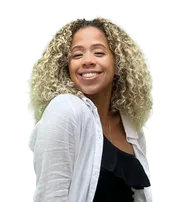
Monica Veloz isn’t interested in filters, photoshop, or AI-assisted images of today’s internet. Even if skin-smoothing photo tools had been popular when she started her beauty and style YouTube channel MonicaStyleMuse in 2016, presenting herself as polished and perfect was never the goal.
She was simply an inspired and vivacious Afro-Latina woman who loved self-expression and didn’t see many people online with her skin and accent.
“I didn’t start my channel thinking, ‘I’m building a brand,’” Veloz says. “I just wanted a place where I could be creative and be myself. I had always been into clothes and makeup, but I didn’t see a lot of girls who looked like me being centered in that world.”
“Girls who looked like me” meant a Black woman with Dominican heritage and culture, but it also meant women with less-than-perfect skin. Ads everywhere seemed to be focused on having an airbrushed face, and as someone who lived with eczema since high school, that wasn’t Veloz.
“I had what I like to call the perfect skin storm: eczema, acne, and hyperpigmentation,” she says. “So when I decided to go on social media, I realized, ‘My gosh, like if I'm going to be in the beauty space, I'm going to have to share myself, my bare skin.’ That took a lot of guts for me.”
But you know what they say: No guts, no glory. That impulse to show up fully without sanding down the parts that didn’t fit neatly into the beauty industry’s narrow ideals has become the foundation of her work.
Now, a decade after uploading her first video, she’s blazed an inspiring and mighty trail, amassing hundreds of thousands of followers and winning awards – just by showing up exactly as she is.
No Boxes, No Code-Switching
Veloz’s Dominican upbringing is at the forefront of all she does. She flows effortlessly between languages, punctuating her videos with Spanish and Spanglish phrases. She sees her cultural visibility as a responsibility, but mostly it’s a joy.
“Dominican culture, especially the women in my family, have shaped the way I navigate space,” says Veloz. “Being Afro-Latina influences my style, my beauty choices, the way I move through the world.”
In her early YouTube days when anyone could upload a video and tell their story, Veloz leaned into that freedom, experimenting with what she wanted to share with her audience. What kept her going was the sense that she was building something honest. Even when the audience was small, the connection felt real.
“I think people could tell I wasn’t trying to be anyone else,” Veloz says. “I was just showing up as me. I want people to know that you don’t have to fit into a box. You can be all the things that you are.”
Real Skin, Real Life, on Camera
A defining part of Veloz’s authenticity is her willingness to talk openly about her eczema. Eczema, also known as atopic dermatitis, is a chronic skin condition that causes dry, itchy, bumpy patches. Even though millions of people have it, it’s rarely seen in the glossy world of beauty influencing.
But instead of hiding it, Veloz chose to talk about it. She filmed videos during flare-ups, discussed products that did and didn’t work for her, and shared the emotional side of living with a visible skin condition. In doing so, she struck a chord. Viewers began reaching out with their own stories, thanking her for normalizing something they’d been taught to conceal.
“It opened up opportunities for women to feel seen and to realize they didn’t have to look a certain way,” says Veloz.
As her audience grew, so did opportunities. Brands began to take notice, and influencing became not just a creative outlet but a career. Still, Veloz was determined to protect the core of what made her work meaningful. She says she sees herself as a “vessel” for community, a landing place for people to feel seen and talk about skin, motherhood, style, the world – whatever is creating meaning for them in that moment.
In 2023, her mother passed away, less than a year after Veloz had become a mother for the first time herself. The juxtaposition of these two monumental life events deepened her desire to make real connections and show up authentically.
“There was no way I could sit here and tell you how to do your hair and makeup while feeling like crap,” she says. “I was trying to find out who Monica was in the midst of becoming a mother and losing a mother. It didn't look like this animated version that I used to be. It became real. It helped me realize we're all going through real things, and having those real conversations was like my therapy.”
Opening the Door for Everyone
When she looks at the landscape of beauty media today, Veloz says she can see a shift: freckles, gaps in teeth, acne, even a ban on Photoshop for some brands. She’s hopeful that brands are getting the message that people have a deep need for what’s real.
“As a consumer, the second I see someone with acne-prone skin, eczema, or hyperpigmentation, I'm tapped in,” she says “And I think we'd be surprised at how many of us struggle with something. It's important for the media to give space and room for people to be seen because real skin matters.”
When she thinks about her career future, she’s less focused on metrics and more interested in impact. She hopes to continue expanding the conversation around beauty, particularly for people who’ve felt excluded from it.
“Beauty should be expansive,” she says. “There’s room for all of us.”